The Edo Media That Became Shonen Manga
The interview, announced through a PR TIMES release carried by the Japanese entertainment news site Mantan Web, frames the whole project as what it calls "Reiwa ukiyo-e," ukiyo-e for Japan's current era. The artisans behind it mean that framing literally. Kenji Takenaka, the fifth-generation printer at Takenaka Mokuhan Takezasado and the project's overall supervisor, points out that ukiyo-e was the mass media of its day. Edo-period warrior prints played the same role shonen manga does now, and prints of kabuki actors and teahouse girls worked like idol photos. The release also traces manga's development back to Hokusai Manga, the sketch collection ukiyo-e master Katsushika Hokusai published as a drawing manual.
"Anime and manga have continued straight on from ukiyo-e," Takenaka says in the interview. "This time the subject wasn't a kabuki actor. It was My Hero Academia, which the whole world admires."
Takezasado has the credentials to back the talk. The workshop was founded in 1891, and Takenaka's own woodblock work is held by the Museum of Fine Arts, Boston, among other overseas museums.
Deku Fights MMA, Bakugo Rides a Snowboard
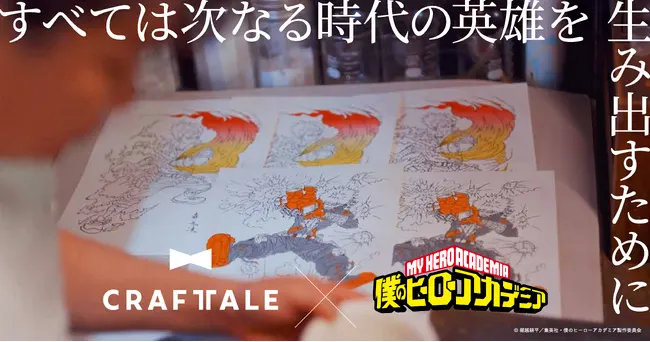
The three prints picture Izuku Midoriya, Katsuki Bakugo, and Shoto Todoroki in imagery inspired by the story's final battle, and they're composed so the three images connect when hung side by side.
The poses came about in an unusually physical way. Takenaka, who practices martial arts and snowboards, modeled each pose himself, and artist-carver Kazuki Nojima drew from there. Deku, who inherits a range of Quirks, gets an all-around mixed-martial-arts stance that Takenaka describes as acrobatic and traditional at once. Bakugo is drawn mid-air, like a snowboarder launching off a jump, with his competitive streak expressed in the vertical square motifs behind him. Todoroki's love of soba pushed the team toward a traditional Japanese feel, so his pose references a karate kata, set against an orderly background that matches his quiet temperament.
There's a collector-friendly detail in the backgrounds, too. Takenaka designed them as geometric patterns specifically so that any of the three characters can hang in the center position, whichever hero the buyer loves most.
Brush Lines, Not Screenshots
None of this was traced from the anime. The prints were drawn from scratch following Edo-period ukiyo-e methods, and the details show it. The black outlines swell and thin like brush strokes and deliberately avoid clean straight lines, a quality Takenaka ties to the handmade lines of historical ukiyo-e. The color gradations at the top of each print are a woodblock-specific technique, and the release suggests holding the prints up to the light to appreciate how flat and even they are.
Nojima, who both drew and carved the images, credits the source material for making his job possible. However he drew the three heroes, he says, they still read as themselves, which he takes as proof of how strongly original creator Kohei Horikoshi and the anime's staff built these characters.
Looking Ahead
The full interview and a video version are live on the CRAFTALE official site, and they go further than the release does, covering why woodblock printing survived in Kyoto and how the price of a bowl of soba once shaped ukiyo-e composition. The prints themselves went on sale July 31, 2026, priced at ¥55,000 each per CRAFTALE's store pages. HIKE, the company behind the CRAFTALE brand, also says a follow-up article told from the project planners' side is in the works. The release doesn't say whether CRAFTALE ships internationally, so overseas fans will want to check the store pages directly.