Too Detailed to Animate
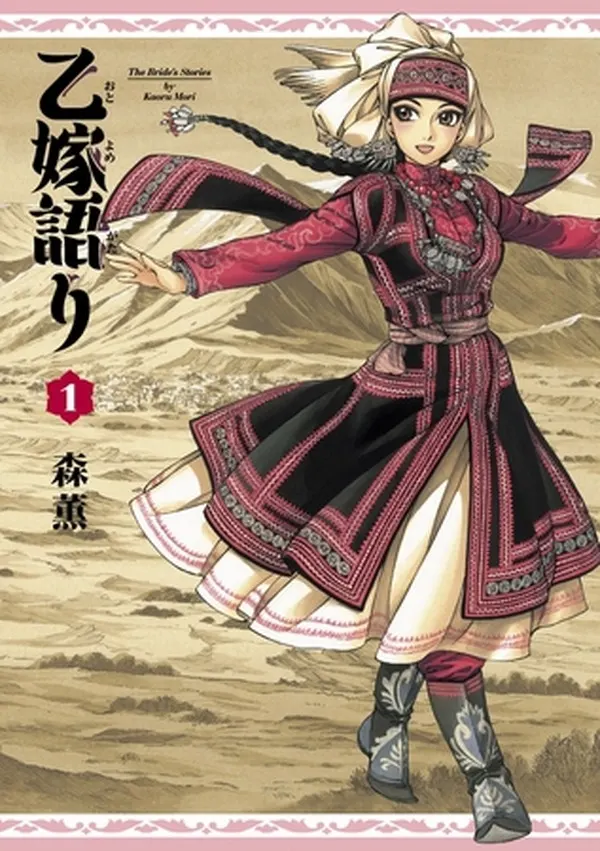
The piece comes from Anime Anime's recurring Recommended Manga Notebook column, where the Japanese anime news site's editors spotlight manga they want to see animated. When this installment's editors try to guess why no studio has touched A Bride's Story, they start with the drawings themselves. Kaoru Mori works every page to the corners: embroidery on folk costumes, hair ornaments, woven textiles, buildings, tableware, horse tack, and the open landscapes of the steppe.
The column singles out the costumes as the series' signature. Because Mori draws the layering of cloth, the fine stitching, and the texture of every ornament, the column argues, a reader can feel the local culture, a family's history, and the hours a maker spent on a single garment. Translating that to film would demand an enormous drawing load and serious research. An anime would have to keep intricate costume patterns intact while characters move, send horses galloping across open country, and make every household tool look convincing. That production hurdle, the editors suggest, may be what has kept the series off the screen for so long.
Then the column flips its own argument. Cloth catching the wind. A cooking fire flickering while steam rises off a pot. Fingers driving an embroidery needle one stitch at a time. Images that sit still on the page would gain the flow of time, and the editors write that they want to see what kind of world opens up once those images start moving. They are also careful to note that a good adaptation does not mean tracing Mori's linework frame by frame. What they want is the texture of the culture her pen conveys, rebuilt in ways only animation can manage.
A Marriage Plot That's Really About Daily Life
A Bride's Story, published in Japan as Otoyomegatari, opens in Central Asia in the late 19th century, near the Caspian Sea, where 20-year-old Amir arrives as a bride for 12-year-old Karluk. From that setup the series widens into an ensemble drama about nomadic and settled peoples, following marriage, family, work, meals, and clothing across different cultures. Later arcs shift the spotlight to other women, including Talas, the twins Laila and Leily, and Pariya, each of whom faces marriage on very different terms. Some have their matches arranged by family, some try to choose for themselves, and some make hard decisions to stay with the person they love.
The column pushes back on reading it as simply a story about weddings. What Mori is really drawing, the editors argue, is what it means to live with someone: sharing a table, sewing clothes, keeping a house, raising children, and caring about another person enough to work with your hands on their behalf.
The manga has collected plenty of awards along the way. It took second place in the 2011 Manga Taishō, won the prize outright in 2014, and picked up the Prix Intergénérations at France's Angoulême International Comics Festival in 2012. Volume 15 arrived in Japan in November 2024, followed by a larger wide-format edition of the same volume in February 2025. The original art has even traveled to the region the story depicts, with an exhibition held in Kazakhstan.
An Anime You Would Listen To
The column's most specific request is sound. A loom at work, cooking in progress, hoofbeats, wind crossing the grassland, a family talking over a meal: the editors want to hear the noises readers have been imagining for nearly two decades. They sketch two versions of how it could go. One layers music with a Central Asian flavor over horses crossing vast landscapes. The other holds the music back entirely and lets a crackling fire and the sound of wind carry a quiet family scene. Either way, the pitch is an anime built around the sense that people actually live in this world, rather than one that pushes action or romance to the front.
Looking Ahead
To be clear, nothing has been announced. The column is a wish list, not a report, and as of August 2026 no A Bride's Story anime exists in any form.
English-speaking readers are fully covered on the manga side, though. Yen Press publishes the series in North America, and all 15 volumes are available in English, with volume 15 released on December 16, 2025. In Japan, the series began in Enterbrain's Fellows! magazine (later renamed Harta) in October 2008 and currently runs in Kadokawa's Aokishi magazine.
Mori's work has also made the jump to animation before. Her earlier Victorian maid drama Emma: A Victorian Romance received two TV anime seasons, in 2005 and 2007. Whether A Bride's Story ever follows depends on a studio willing to take on all that embroidery. Until then, the page is the only way into Amir's world, and Anime Anime's column reads as an open invitation for someone to change that.