The Director Who Skipped TV Anime Entirely
Kadowaki was born in 1996. He studied design at Tokyo University of the Arts, joined an animation studio after graduating, then went independent and worked on stage visuals and commercials before settling into music videos as his main line. His credits there include the YOASOBI clip "Yasashii Suisei." We Are Aliens is the first feature he has planned, written and directed, and it went straight from that music-video background to the 79th Cannes Film Festival's Directors' Fortnight in May 2026 and the Annecy International Animation Film Festival's feature competition.
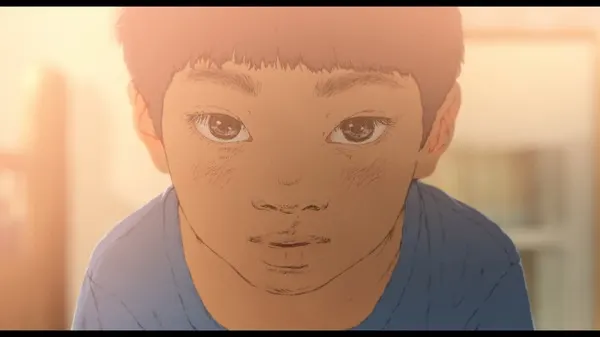
The film itself is a coming-of-age nostalgia piece set in a rural Japanese town during the Heisei era. It follows 30 years of friendship between Tsubasa, a shy boy who worries about being "ordinary," and Gyōtarō, the popular kid everyone treats as "special." Ryōta Bandō voices the adult Tsubasa and Amane Okayama voices Gyōtarō, with Ten Yamasaki of the idol group Sakurazaka46 as Konatsu and Kemuri Matsui as Batahara. Yūto Maki, Tasuku Nakagome, Saki Suzuki and Haru Suenaga play the characters as children.
In the Anime Anime interview, Kadowaki said the idea started as a vague wish in his early twenties to preserve his own childhood in animation, since he is an artist. There was no story yet, just fragments. Four years ago he met producer Hayashi, and the two agreed to turn it into a feature. He built the script outward from a single midpoint turn where the film's point of view switches, then worked down to the arc of the first half and finally to the beats of each elementary-school year. Only 20 to 30 percent comes from his own life, he said, though the first-love material is real.
Building an Emotional Rollercoaster
Early in production, Kadowaki realized that stringing together striking images would not hold an audience for two hours. What he needed was rhythm, so he started thinking about story pacing like a rollercoaster: a ride that never slows down gets boring, but a pause at the top before a sudden drop keeps people engaged. He pointed to the moment in Spirited Away where Chihiro nervously descends a staircase, slips, and suddenly accelerates as the kind of beat he studied. He rewrote the script until the producer finally gave it a passing grade.
The film's dense, realistic visuals came from the same goal. Kadowaki wanted viewers to feel their own childhood, so he packed the frame with small, specific details: the way a randoseru backpack wears out, the way a school desk gets chipped at the corners. Scatter enough of those triggers through the film, he reasoned, and every viewer will snag on something and remember their own past. That meant backgrounds, props and characters all had to carry the same amount of information, and he describes the result as the latest version of his own naturally dense drawing style rather than a departure from it.
To keep characters from floating on top of the backgrounds, he had the background staff draw with the same brushes used for the character art, then did the color grading on every single cut himself. He also served as art director, animation director and editor, and sat in on post-production from the start. That, he believes, is what kept the film's tone consistent from start to finish instead of turning it into a patchwork of departments.

Rotoscope for the Body, Anime for the Hair
Kadowaki shot live-action reference footage for nearly every cut in the film, both the childhood and adult scenes. Child actors chosen through auditions performed the kids' parts, and when time ran short he acted the scenes himself. The footage was for movement only, not layout: even close-ups were filmed wide.
He used rotoscoping on parts of the film, but stressed that tracing live footage straight does not automatically produce the intended look. Kids can stop looking like kids, and a woman's shoulders can read wider than they are. So the core body motion comes from rotoscope while clothing and hair are drawn with more conventional anime flourish and allowed to flow. The payoff is in the kind of movement animators normally train themselves out of: the pointless fidgeting and odd running styles of actual children. For those scenes he gave the child actors only the situation and let them improvise, because detailed direction would have killed exactly what he wanted.
The lens-conscious layouts that press at Cannes singled out were, by his own account, not something he thought of as a signature until reporters brought it up. He decides how large a subject should sit in the frame first, then picks the lens that gets him there. He bought a DSLR for location scouting, but credits the instinct to the fact that roughly 80 percent of what he watches is live-action.
Asked about his influences, Kadowaki listed the Doraemon films, Studio Ghibli and 1980s movies, plus Naruto on the manga side and Impressionism and 17th-century realism in painting. The '80s habit came from his father: The Terminator, Back to the Future, Jackie Chan, Bruce Lee. He admits his taste runs mainstream, and he named Parasite and the films of Hirokazu Kore-eda as recent examples. He also made a point of keeping We Are Aliens easy to follow, since films people call impenetrable usually lose him too.
Looking Ahead
We Are Aliens opens in Japanese theaters on September 25, 2026, distributed by TOHO NEXT and NOTHING NEW, the label that planned and produced the film with cooperation from France's MIYU Productions. Yaffle composed the score and wrote the theme song "Sasakure," performed by adieu. The film runs 118 minutes.
After Cannes and Annecy, the film was also selected for the feature competition at the Ottawa International Animation Festival 2026. Australian audiences can catch it at Japanese Film Festival screenings running from October through November 2026, and Variety reported that sales agent Charades has sold the film widely across Asia. No North American or European theatrical distributor or streaming partner has been announced.
Kadowaki's parting note for anyone heading to a screening: his staff licensed real items that Japanese kids collected in the Heisei years and hid them throughout the film. He does not expect anyone to spot them all on a first viewing, and suggests comparing counts with friends afterward.