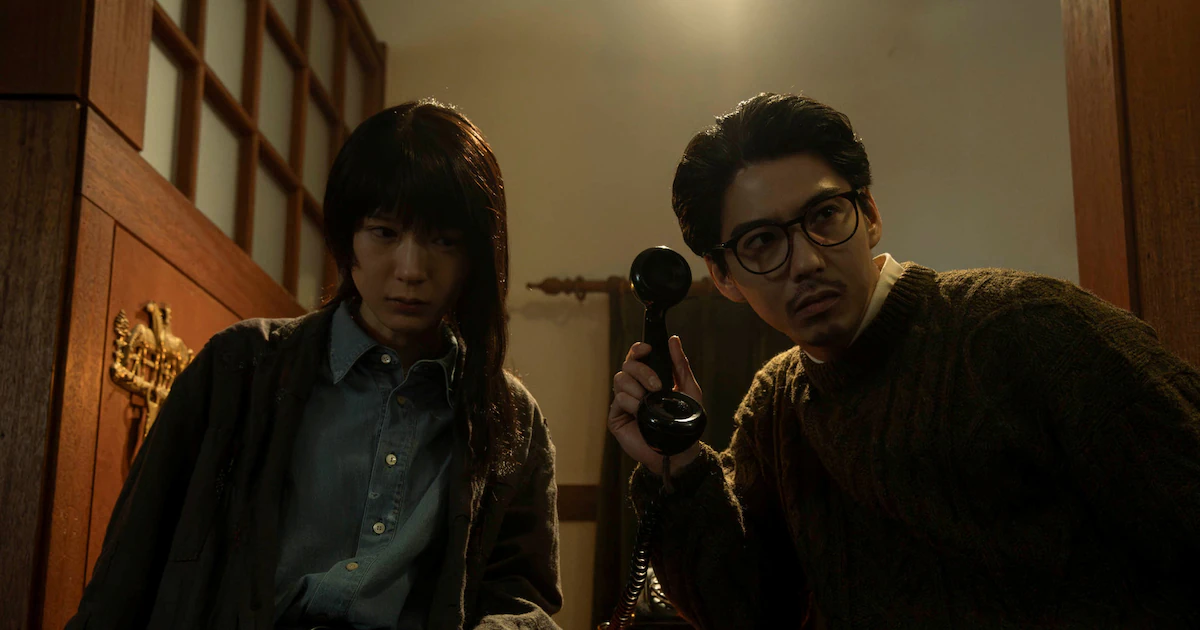
A Haunted Mansion, a Spirit Medium, and a House of Ninjas Reunion
Never After Dark marks the first theatrical film from SIGNAL181, the production company Kento Kaku and Dave Boyle founded in 2024 after collaborating on the Netflix hit House of Ninjas. Boyle directs; Kaku produces and co-stars. The result, based on audience reactions compiled by Movie Natalie, is something that splits the difference between traditional J-horror and Western genre filmmaking in a way neither side has quite attempted before.
The premise follows Airi, a young spirit medium born into a family of psychics, and her older sister Miku — who became a ghost after an unspecified incident. The sisters travel the country solving supernatural cases until a new request sends them to a remote Western-style mansion in the mountains. The owner, Teiko, wants a male apparition exorcised. Her son Gunji thinks the whole thing is nonsense. Then things get ugly fast: strange phenomena escalate, Airi encounters the ghost mid-ritual, and buried secrets about the mansion, the sisters' past, and the apparition's true identity begin clawing their way to the surface.
Moeka Hoshi (Usami Fuji in FX's Shogun) leads as Airi, with Kurumi Inagaki (稲垣来泉) as ghost-sister Miku, Tae Kimura as Teiko, and Kaku himself as the skeptical Gunji. Mutsuo Yoshioka and Bokuzo Masana round out the supporting cast.
Premiere Audiences Call It a New Kind of Horror
The Japan Premiere took place on April 28 at TOHO Cinemas Shinjuku, with Movie Natalie readers in attendance. The consensus was striking: multiple attendees described the film as a genuine evolution of Japanese horror. One called it "a completely new horror film where the type of fear changes between the first and second half." Another described the experience as "connecting dots until you hit that moment of understanding — the goosebumps were unreal."
Attendees highlighted the film's genre-blending approach. The story weaves suspense and mystery into its horror framework, and several viewers noted they left wanting to rewatch immediately to catch what they'd missed. "Scary, sure, but my curiosity about what would happen next was bigger than the fear," one audience member wrote.
Kaku set the tone at a pre-screening stage greeting, describing the film as something audiences could "enjoy from the heart, like a haunted house — with real scares, of course." That framing landed. Multiple attendees compared the experience to a theme park ride, praising the film's density of genres: horror, human drama, action, and what several described as a fascinating "ritual system" for the exorcism sequences.
Practical Filmmaking and Moeka Hoshi's Breakout Lead
Boyle committed to minimal CGI throughout production, and the premiere audience noticed. Viewers praised the film's visual restraint — steady camerawork, carefully controlled lighting, and a film-like grain that one attendee said "pulled you in through the images alone." Sound design drew particular attention: "In the silence, a single small noise grabs your nerves." One audience member compared Boyle's approach to the early work of Nobuhiko Obayashi, citing "an irresistible charm" in the direction.
Hoshi's performance as Airi emerged as the film's anchor. Attendees described her as "transcendent but slightly oblivious — she knows the spirit world, so ordinary scares don't faze her, but you can tell she understands the fear better than anyone." Her physical performance drew specific praise for its "unique rhythm and originality." One viewer put it bluntly: "No one else could have played that character." Multiple attendees expressed a desire for a follow-up series following the sisters on more cases.
East Meets West — and It Works
The Japanese-American creative partnership at the film's core produced exactly the fusion audiences seemed to hope for. "The dimly damp atmosphere of Japanese horror and the direct, punch-you scares of Western horror — plus a little humor — blended perfectly," one attendee wrote. Another detected echoes of internationally acclaimed Japanese directors like Takashi Miike and Kiyoshi Kurosawa in Boyle's horror vocabulary, but noted that "something fundamentally non-Japanese mixed into the foundation creates a strange, lingering aftertaste."
Several attendees connected this cross-cultural quality to the film's global potential. As one viewer put it: "I'm convinced this connects to something that works worldwide."
Looking Ahead
Never After Dark opens in theaters across Japan on June 5, 2026. No international distribution has been announced yet, though the Kaku-Boyle partnership's Netflix pedigree — House of Ninjas hit number one on the platform's global non-English chart — suggests streaming availability outside Japan is likely a matter of when, not if. The film is SIGNAL181's debut production, and based on these premiere reactions, the company's first swing appears to have connected.