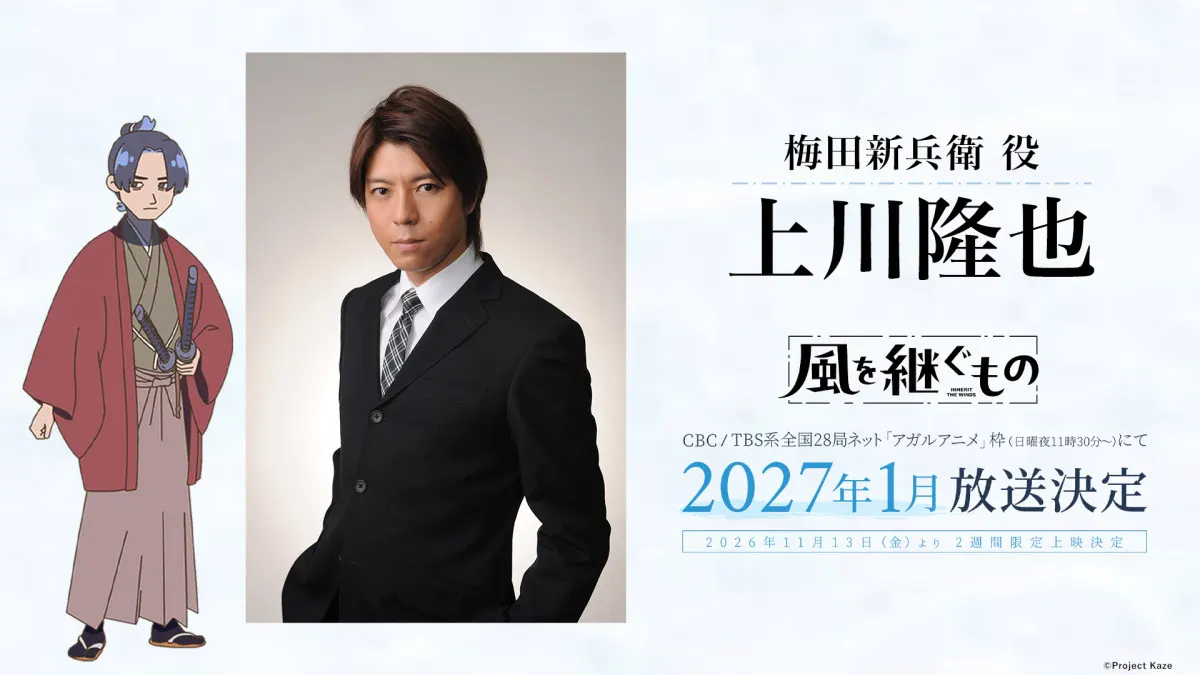
Takaya Kamikawa Returns to a Story He Performed 30 Years Ago
Takaya Kamikawa (the Anti-Spiral in Gurren Lagann, Ishitsukuri no Miko in Studio Ghibli's The Tale of the Princess Kaguya) plays Shinbei Umeda (梅田新兵衛), a mysterious man who calls himself a samurai of the Iwakuni domain and keeps tailing protagonist Jinsuke Tachikawa. The Oricon News report from the Japanese entertainment news outlet only teases how Umeda will figure into the larger story.
The casting has a personal angle. Kamikawa was once a mainstay of Caramelbox, the theater troupe founded by Inherit the Winds screenwriter Yutaka Narui, and that connection is why his role is billed as a "friendship appearance," the Japanese industry term for a guest role taken on as a favor. Caramelbox staged its own Shinsengumi play, Kaze wo Tsugu Mono (風を継ぐ者), 30 years ago, and Kamikawa played Toshizō Hijikata in it.
In his comment, Kamikawa said he still remembers a line his Hijikata threw at Okita in that production: "Don't look at me like that! You make it seem like I'm trying to kill you!" He added that he is happy both to see the play reborn as animation and to take part as a performer, though he could not say for certain whether that particular line survives in the anime.
What the Theatrical Advance Version Covers
The theatrical cut, subtitled -Hajimari- ("Beginning"), focuses on Jinsuke and his Mibu Roshigumi comrades and their dealings with Kamo Serizawa, the group's chief commander. The trailer, posted on Aniplex's official YouTube channel, builds an uneasy mood around Serizawa as the story moves forward.
For readers who need the setup: Inherit the Winds is an original anime from Aniplex, Live2D and animation studio Drive, billed as a new-style historical drama about the fleeting youth of young people living through Japan's turbulent late-Edo period. The production fuses Live2D with traditional cel animation. Daisuke Sakuma of the nine-member group Snow Man, in his first lead role in a TV anime, voices Jinsuke, a Mibu Roshigumi member who has lost his memory. The Mibu Roshigumi is the group that would later become the Shinsengumi.
Tomohiro Kawamura directs, with Fumi Ebina on character design, per the official site. The main cast around Sakuma includes Yūki Kaji as Sōji Okita, Aoi Yūki as Hyōgo Koganei, Kōki Uchiyama as Toshizō Hijikata, and Yūichi Nakamura as Isami Kondō.
Quruli and Hitsujibungaku Share Both Theme Songs
The music news is a two-band collaboration. The ending theme, "Namida no Kawa" ("River of Tears"), is credited to Hitsujibungaku + Quruli and also serves as the theme song for the theatrical advance version. The opening theme, "Kaze wo Tsugu Mono," flips the billing to Quruli + Hitsujibungaku. Both songs were written specifically for the series.
Quruli frontman Shigeru Kishida also composes the show's score. Hitsujibungaku said that after seeing footage with the score attached, they decided the ending theme's job was to capture the freshness of the characters' emotions. They described working with Kishida as stimulating, saying his arrangements of their demos went beyond anything they expected. Kishida described "Namida no Kawa" as emotional and fleeting, a song whose vocals, lyrics and melody wring the heart. Of the opening, he said the sound is like Hitsujibungaku racing through Quruli's vast sonic world, with a voice like the wind ringing out across a fantastical soundscape that links back to the score.
Looking Ahead
The theatrical advance version, Inherit the Winds -Hajimari-, opens in Japanese theaters on November 13, 2026 for a two-week limited run. The TV series follows in January 2027 on the CBC/TBS network's Agaru Anime block, which airs Sundays at 11:30 PM across 28 stations in Japan.
No international streaming partner has been announced yet. Since this is an original anime rather than a manga adaptation, there is no source material to read in English in the meantime; the closest thing is Narui's original stage play, which has not been published in English.
(C)Project Kaze