Two Hit Adaptations, Two Hands-Off Novelists
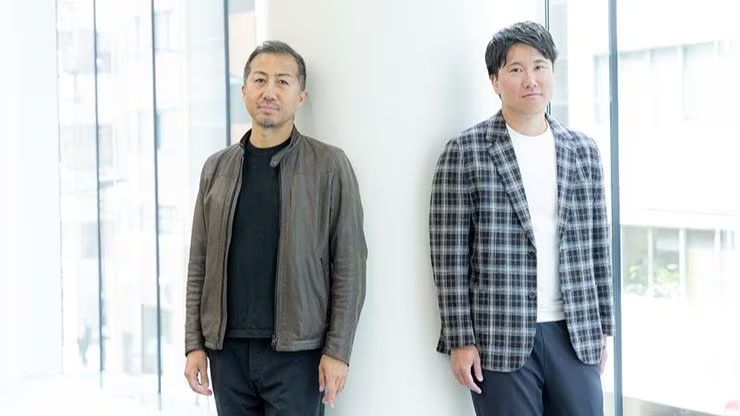
The conversation, published by Shueisha Online, Shueisha's news and culture site, pairs two writers whose books recently made the jump to the screen. Ko Shinjo (新庄耕) wrote Jimenshi-tachi, a crime novel about con artists who impersonate landowners and pocket the sale money. It became Netflix's Tokyo Swindlers in 2024 and grew into what the article calls a social phenomenon. Shinichiro Yuki (結城真一郎) wrote the short story collection #Shinsō o Ohanashi Shimasu (roughly, "#LetMeTellYouTheTruth"), which became a live-action film last spring and topped ¥2 billion (approx. $13 million) at the Japanese box office after opening in April 2025.
Neither writer hovered over his adaptation. Shinjo says his entire contribution to the Netflix series consisted of telling Hitoshi Ōne, who proposed the project and handled both script and direction, "I leave everything to you." Yuki checked the film's script and otherwise left things to the professionals, even after being told at the planning stage that his independent short stories would be rebuilt into a single feature-length plot with a new central thread. The idea had never occurred to him, he admits, but he decided a film justified changes on that scale.
A Detective Who Never Leaves the Kitchen
The talk is timed to the paperback release of Nanmon no Ōi Ryōriten (難問の多い料理店, roughly "The Restaurant of Many Puzzles"), a title that reads as a play on Kenji Miyazawa's classic The Restaurant of Many Orders. Yuki's linked short story collection is set at a ghost restaurant, a delivery-only kitchen with no seats for customers, where the chef solves mysteries without ever going outside. The couriers who cycle through his kitchen serve as his eyes, ears, and legs. Yuki calls the setup a present-day take on the armchair detective, an idea that clicked while he and his editor at Shōsetsu Subaru, Shueisha's fiction monthly, were settling on food delivery as the book's subject.
The hardest part, Yuki says, was inventing puzzles that could only exist in the delivery economy. He points to two of them: a customer whose orders are brought by the same courier ten times in a row, and food that keeps arriving at a vacant apartment. Shinjo praised the couriers' own storylines just as much, singling out the third story about a single mother raising her son in a Tokyo apartment while working deliveries. Yuki says he read working couriers' blogs while writing and channeled what seeped through between the lines into his characters.
Why Food Delivery, and Why Now
Yuki was frank about the strategy behind the setting. Since #Shinsō o Ohanashi Shimasu, he has pushed ideas that only the current moment makes possible, reasoning that the genre's giants never had the chance: Edogawa Ranpo and the classic mystery writers never saw a food delivery app. Fresh material, he says, gives a newer writer a way to hold his own against a century of classics.
Shinjo's origin story for Jimenshi-tachi is more accidental. An editor pitched him the subject outright. The idea surfaced when the editor was drinking with a real-estate contact and talk turned to the Sekisui House land-fraud case, an incident Shinjo was already interested in. He also traced his own path for Yuki: he debuted through a pure-literature prize, concluded he could not survive there, and moved to entertainment fiction. He cannot write mysteries like Yuki's, he says, but a story like Jimenshi-tachi felt within reach, and his lingering habit of obsessing over what characters think and how they have lived is, he jokes, the residue of his literary roots.
The two also compared notes on what to do when ideas stall. Yuki walks, endlessly, once coming home with feet so blistered they left red footprints on his floor. Shinjo goes drinking.
Looking Ahead
International readers can already reach half of this pairing. Tokyo Swindlers streams worldwide on Netflix, and Shinjo's source novel received an English edition, translated by Charles De Wolf, in November 2024. Yuki's work has not made the jump yet: neither #Shinsō o Ohanashi Shimasu nor Nanmon no Ōi Ryōriten has an announced English edition, and the new paperback is Japan-only for now. The full three-page conversation is available in Japanese on Shueisha Online.