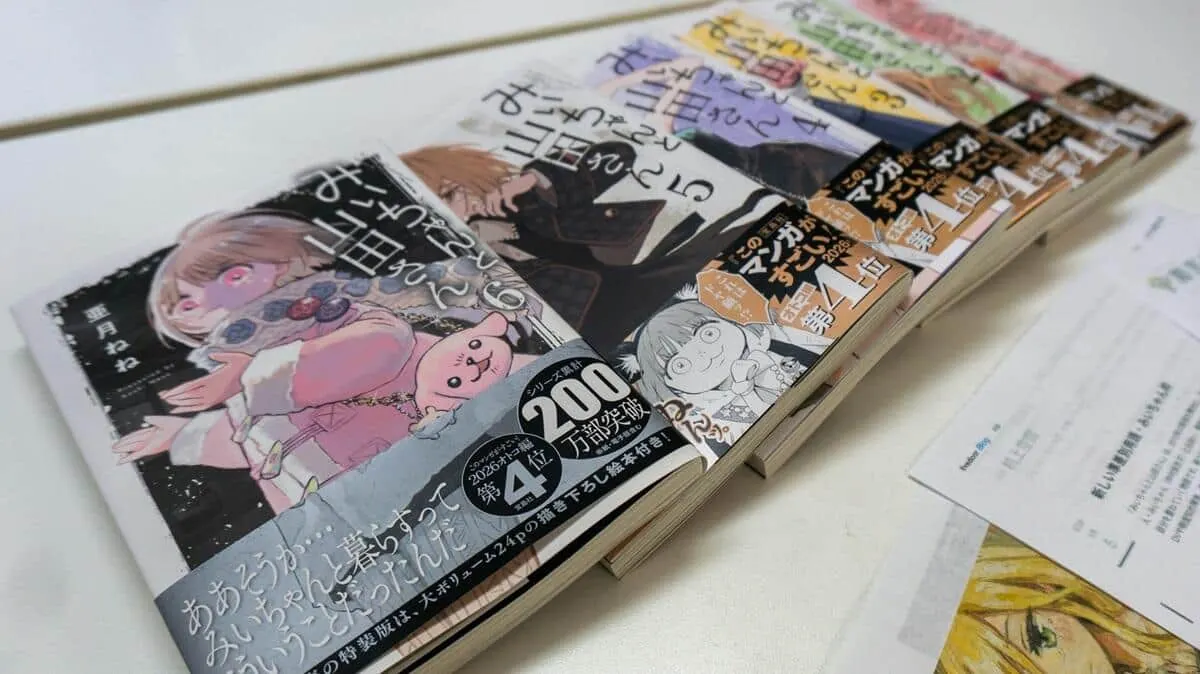
A Japanese association of people with developmental disabilities says a reply declining to protest the anime adaptation of the manga Mii-chan and Yamada-san was the personal answer of the staff member who handled the inquiry, not the group's official position. The association, the Hattatsu Shōgai Tōjisha Kyōkai (発達障害当事者協会), gave that account in a July 28, 2026 interview published by J-CAST News on August 27, 2026.
The adaptation was announced on July 26, 2026 for a 2027 release, shortly before the manga ran its final chapter on August 16. According to J-CAST, cumulative circulation of the Kodansha series, including digital editions, has passed 3 million copies. Seven Seas Entertainment has licensed it in English as Mii-chan and Yamada-san and says volume 1 will be printed in English for the first time in December 2026.
The story opens with Yamada-san visiting Mii-chan's grave, then returns to Kabukicho, Tokyo in 2012 and covers the 12 months from the two women's meeting at a hostess club until Mii-chan is killed. Mii-chan repeats the same mistakes and breaks club rules, and the manga later shows that she fell behind at school from her elementary years and stopped attending after her mother and grandmother objected to a teacher's suggestion that she transfer to what was then called a special class.
Reaction to the announcement was divided, J-CAST reported. Supporters said they wanted the story to reach more people, opponents said an anime would encourage discrimination and prejudice, and an online petition against the adaptation circulated. The production committee responded on X on July 27, saying it was taking the concerns seriously and had decided on the adaptation because it saw value in presenting the work as animation. It said it would respect the themes and message of the original work and proceed carefully, seeking expert advice and adding appropriate ratings and advisory notices so as not to encourage prejudice or misunderstanding. The work's official account said the same day that the manga had not been created with the intent to discriminate against or look down on people with particular disabilities or in particular positions.
Requests to protest the adaptation also reached the association, which was founded in 2015 and is made up of people with developmental disabilities and supporters. The request said Mii-chan's behavior and failures, which it described as suggesting an intellectual or developmental disability, are drawn in ways that invite ridicule and insults, and that people online were already being insulted by being called Mii-chan. The staff member who answered wrote that the association does not consider the work itself discriminatory, that it sees an awareness-raising aspect in the way the work puts current problems to society, and that the association had no plans to protest.
The full text of that reply was then posted on an anonymous message board. The person who had sent the request started a thread saying the response was disappointing, and more than 900 comments followed, including posts urging that person to set fire to the association's building. One staff member said the association consulted police about those posts and later received an apology from the person who had sent the request.
The message also spread on X, where some users presented it as though people with intellectual and developmental disabilities collectively held that position. The association said it had not expected a reply written for a single inquiry to be circulated widely through an anonymous message board, and that it regards cases where the answer is treated as the consensus of all people with intellectual or developmental disabilities as contrary to fact.
The association said it is not in a position to comment on whether a particular work should be adapted. It described the manga as falling within the scope of freedom of expression and not intended to mock vulnerable people, while acknowledging that some people are ridiculed and made uncomfortable because of it. On that basis it asked Kodansha to take certain steps, a request made before the July 27 statements. The association said it plans no further action of its own and that the question now is how Kodansha, as the publisher, responds, including keeping expression that invites discrimination out of the anime. One staff member said the production committee had intended from the start to bring in a supervisor.
In the second part of the report, published August 28, 2026, the staff member explained the awareness-raising wording, telling J-CAST that people who throw stones at such depictions will always appear and that it is entirely understandable that some people fear the work spreading.