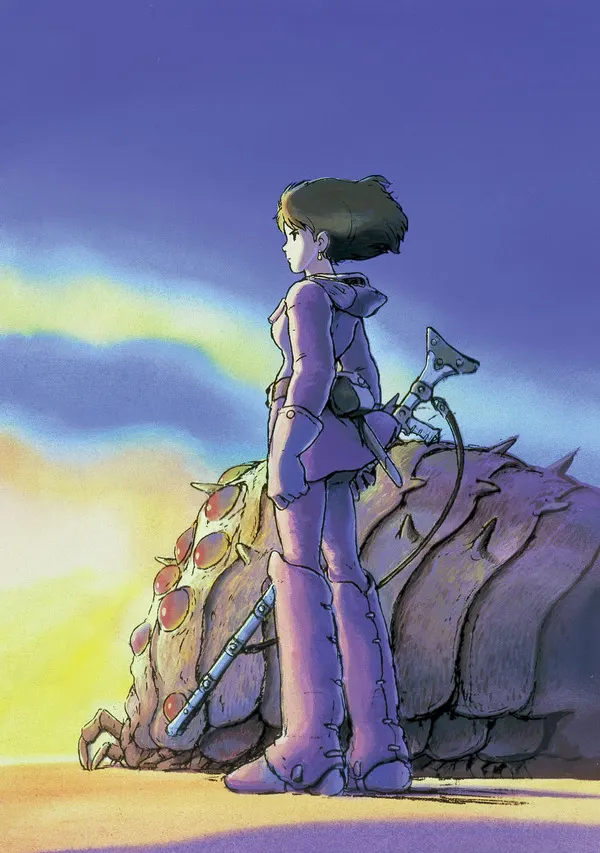
A Voice Cast Stacked With Anime History
Tonight's broadcast is a reminder of how deep this film's bench was. Sumi Shimamoto, who voiced Clarisse in Miyazaki's Lupin III: The Castle of Cagliostro, plays Nausicaä, the wind-riding princess who soars over the toxic jungle on her Möwe glider and can even connect with the enormous insects called the Ohmu.
Her opposite number is Yōji Matsuda as Asbel, the son of Pejite's leader who survives a Tolmekian attack on his city and sets out for revenge. Matsuda would go on to voice Ashitaka in Princess Mononoke, so tonight you can hear two Miyazaki leading men from the same actor, 13 years apart.
The rest of the cast reads like a roll call of classic-era voice talent, according to the broadcast roundup from Japanese anime news site Anime Anime: Gorō Naya as the master swordsman Yupa, Yoshiko Sakakibara as the armored Tolmekian commander Kushana, Iemasa Kayumi as her ambitious staff officer Kurotowa, and Ichirō Nagai as the Valley retainer Mito. Miina Tominaga voices Lastelle, the Pejite princess whose dying words set the entire plot in motion.
The Story: A Princess, a Toxic Jungle, and a Buried Weapon
The film is set 1,000 years after the Seven Days of Fire, a war that burned civilization down. Humanity now lives in fear of the Sea of Decay, a spreading jungle whose trees exhale poisonous miasma, and of the giant insects that guard it. The Valley of the Wind sits on the jungle's edge, a small and peaceful kingdom.
One night, a massive ship from the military power Tolmekia crashes in the valley. Nausicaä reaches the wreck in time to hear Lastelle's final plea: burn the cargo. That cargo turns out to be a God Warrior, one of the humanoid weapons used during the Seven Days of Fire. It was unearthed deep beneath Pejite, seized by Tolmekia, and lost mid-transport in the crash. Soon the Tolmekian army arrives in the valley to claim it back.
The roundup also spotlights the Ohmu, the armored giants of the Sea of Decay whose eyes turn from blue to red when they rage and whose shells are prized for swords and armor. It also introduces Teto, the fox-squirrel Yupa rescues, who trusts no human except Nausicaä.
Made a Year Before Studio Ghibli Existed
Nausicaä opened in Japanese theaters on March 11, 1984, a year before Studio Ghibli was formally founded, and its core team became the studio's foundation. Miyazaki handled original story, screenplay, and direction, adapting his own manga. Isao Takahata, later the director of Grave of the Fireflies, produced. Joe Hisaishi composed the score, the first of his soundtracks for a Miyazaki film to reach this slot tonight, including pieces like "Nausicaä Requiem" and the closing "Bird Person." The film now carries the Studio Ghibli copyright, and tonight's version is billed as a Studio Ghibli special edit.
Looking Ahead
The broadcast runs from 9:00 p.m. to 11:24 p.m. JST tonight on Nippon TV. For viewers outside Japan, the film is easy to find: it streams on HBO Max in the United States, and Netflix carries it in many international regions as part of its Ghibli catalog.
Miyazaki's original Nausicaä manga, which continues far beyond the film's ending, is published in English by Viz Media, including a two-volume hardcover box set. In Japan, a seven-volume box set is also in print.
As for the Friday Roadshow slot itself, Anime Anime's related coverage notes that a version of Titanic featuring voice actor Akira Ishida is set for September 4 and 11.